Browsed by
Category: Uncategorized

Survey: Majority of Americans have money regrets in 2024

Survey: Majority of Americans have money regrets in 2024

By Erin El Issa, NerdWallet

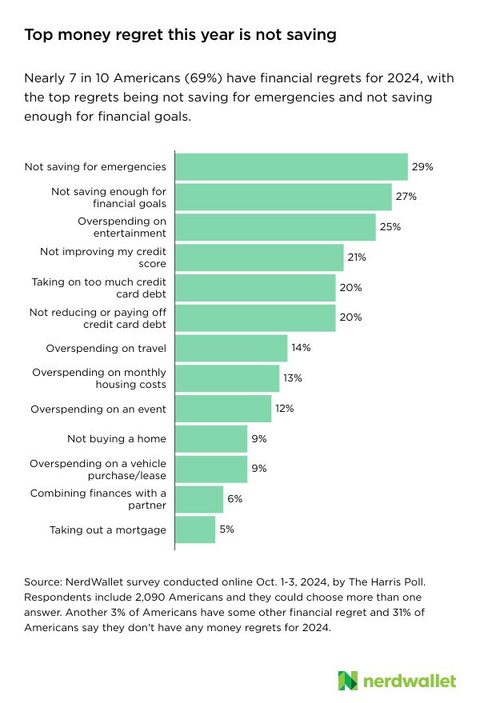
It’s nearly the end of the year and a majority of Americans have regrets about their money moves, or lack thereof, in 2024. Whether they set New Year’s resolutions that didn’t work out, or just thought they’d be further ahead than they are now, a new NerdWallet survey, conducted in Oct. 2024 by The Harris Poll, finds that 69% of Americans have financial regrets for 2024.

The youngest adult generation — Gen Z (ages 18-27) — is most likely to be remorseful about money this year. Nearly 9 in 10 Gen Zers (89%) say they have financial regrets for 2024, compared to 80% of millennials (ages 28-43), 73% of Gen Xers (ages 44-59) and just 46% of baby boomers (ages 60-78).

Among the top regrets are not saving, overspending and not working on credit score improvement.
Chart, Bar Chart

If you count yourself among those with regrets, here are some actions you can take starting today to avoid such remorse next year and beyond.

Regret: Not saving for emergencies and financial goals

Nearly 3 in 10 Americans (29%) regret not saving for emergencies and 27% regret not saving enough for their financial goals, like retirement or a down payment on a home, this year. read more

‘Yes, chef.’ Orlando food bank offers path to culinary career

‘Yes, chef.’ Orlando food bank offers path to culinary career

Jeremy Cooper lost his custodial job at a Sanford commercial bakery because of illness, then spent three years looking for decent-paying work to support his wife and their five children.

But he had limited skills and limited luck.

“I was applying for any job that would allow me to have some income,” Cooper said.

At a job fair in Orlando, he learned about Second Harvest Food Bank’s Culinary Training Program.

“I could see he wanted the next thing, but didn’t necessarily know how to get there,” said Keonna Yearwood, manager of the nonprofit’s culinary program, which trains about 35 people a year to work in professional kitchens.

Cooper said the program wasn’t easy, but he got through it, graduated and now works as a line cook at a sports bar at Hilton Orlando on International Drive, which touts its “all-American eats” menu that includes burgers, fried chicken and macaroni and cheese.

“It feels so good that you can work with these different types of people every single day just for one goal, to get the service done and make sure people are happy,” Cooper said. “And then you get to go home and come back and do it all again the next day.” read more

Spirit Airlines still positioned to fly you home for the holidays despite financial turbulence, observers say

Spirit Airlines still positioned to fly you home for the holidays despite financial turbulence, observers say

One would think that less than a month before Thanksgiving, and two months before the Christmas-New Year’s holiday season, this is not an ideal time for news pages to be filled with reports about an airline’s possible bankruptcy filing, or renewed takeover talk by an old suitor, or a spate of layoffs looming in January.

But the public discussion is one of the realities facing South Florida-based Spirit Airlines as the carrier’s management labors to raise cash and plot a course to return to profitability amid fierce industry competition.

Travelers have choices when they book trips for the year’s busiest travel seasons. As Spirit alters its route network, sells airplanes, cuts capacity and arranges hundreds of furloughs as part of an $80 million cost-cutting program, customers would like to know whether they will be facing changes in their plans.

“I think Spirit is going to do everything possible to minimize disruptions to its customers for the holidays,” said Henry Hartveldt, founder and president of Atmosphere Research Group, an industry consultancy in San Francisco. “One challenge Spirit faces is unfortunately there is a lot of bad news swarming around the airline, and that inspires concern among travelers.” read more

A quarter of all working women are leaving free money on the table that could set back their retirement

A quarter of all working women are leaving free money on the table that could set back their retirement

By Alex Gailey, Bankrate.com (TNS)

A larger share of women than men aren’t saving for their future selves and could be losing out on hundreds of thousands of dollars over their lifetime as a result.

More than a quarter of women (26%) working full-time, part-time or looking for employment didn’t contribute to their retirement savings between August 2023 and 2024, compared to 16% of working men, according to Bankrate’s 2024 Retirement Savings Survey. A similar percentage of Black and Hispanic working women (24%) didn’t contribute to their retirement savings during that time, a slight improvement from last year (29%).

The reasons why women save less for retirement aren’t clear-cut. While the gender pay gap is part of the problem, research also suggests women feel misunderstood in the financial world, which may be driving their behavior. Generally, women are more likely to keep more of their savings in cash, feel less confident about their investment knowledge and report higher levels of financial stress. read more

Where the presidential candidates stand on personal finance issues

Where the presidential candidates stand on personal finance issues

By Anna Helhoski, NerdWallet

Consider this your election cheat sheet to find out what Vice President Kamala Harris and former President Donald Trump are promising to do as they vie for the nation’s highest office. Here’s where the candidates stand on top economic and personal finance issues.

Inflation

Both presidential candidates want to lower prices and slow inflation, but whether a president can directly do so is less certain. Inflation, as measured by the consumer price index, has already slowed to 2.4%, well off its pandemic-fueled peak.

Trump:

  • Place tariffs on imports. Trump wants to place a 10% to 20% tariff on all foreign imports; up to 60% tariff on imports from China; and 100% to 200% imports on automobiles produced in Mexico. He says his tariffs would support U.S. manufacturing and raise revenue. But experts from all over the political spectrum say that his tariff plan is more likely to increase prices in the U.S.
  • Lower gas prices. Trump has pledged to increase oil and gas production on federal lands. The president’s ability to lower gas prices is limited as the price at the pump is more directly influenced by global market forces.
  • Weaken the power of the Federal Reserve. Trump says he wants to bring the Federal Reserve under the power of the president; experts say it could weaken the central bank’s credibility in making interest rate decisions.
  • Cap credit card interest rates at around 10%. The average credit card interest rate is 21.51%, according to Federal Reserve data from May 2024. It would require Congress to enact and would likely face legal pushback.

Harris:

  • Ban price gouging. Harris wants to create rules that would prevent corporate grocers from raising prices arbitrarily. The ban would require approval by Congress. Critics say her plan is mainly an election promise rather than a sound economic policy.
  • Lower prescription drug costs. Harris plans to extend to all Americans a $35 cap on insulin and $2,000 cap on out-of-pocket expenses for seniors. She also wants to make it quicker and easier for Medicare and other federal programs to negotiate prescription drug prices. Experts say her plans could be effective in bringing down costs, but will face pushback from Big Pharma lobbyists.
  • Increase the minimum wage. Harris says she would push to raise the federal minimum wage to at least $15 per hour, up from the current minimum wage of $7.25. The federal minimum wage hasn’t been touched since 2009 and raising it would require approval in Congress.

Dive deeper: How Harris and Trump Want to Battle Inflation and Lower Prices

Taxes

The campaign proposals that would most directly impact consumers are tax cuts and credits.

Trump:

  • Extend tax cuts in his 2017 Tax Cuts and Jobs Act that are expiring at the end of next year. The TCJA includes estate tax cuts and individual income tax cuts.
  • Replace personal income taxes with tariffs. His new plan would place a 10% across-the-board tariff on foreign imports with much more for China. More on that above.
  • Lower the corporate tax rate by one percentage point. Trump wants to cut the corporate tax rate from 21% to 20%.
  • Implement R&D tax credits for businesses. The tax credits would allow businesses to write off 100% of expenses in its first year, including machinery and equipment. It’s a reversal of his 2017 tax cuts that phased out write-offs for R&D expenses in a business’ first year.

Harris:

  • Increase taxes for the wealthy. Harris wants to raise the net investment income tax up to 5% on those with incomes above $400,000. She also wants to increase the highest tax rate on long-term capital gains to 28% on taxable income above $1 million.
  • Increase taxes for corporations. 
  • Expand Child Tax Credit: Harris wants to increase the credit to $6,000 for children under the age of 1; $3,600 for children ages 2-5; and $3,000 for older children.
  • Expand Earned Income Tax Credit for those filers who don’t claim children.
  • Permanently extend the expanded premium tax credits for those who purchase health insurance through the health insurance marketplace.
  • Increase tax incentives for small businesses. An increase in federal tax incentives from $5,000 to $50,000. The deduction would be available to new businesses until they turn a profit. The incentive feeds into her goal of creating 25 million new small businesses in the next four years.

No tax on tips: The candidates’ aims are vastly different, but there’s one proposal they both support: exempting workers from paying taxes on their tips. But experts say it’s just bad policy that doesn’t get to the fundamental needs of tipped workers.

Dive deeper: What Trump and Harris Have in Store for Your Taxes read more